Roman Instrument Model Details
STPSF provides a framework for instrument PSF calculations that is extensible
to other instruments and observatories. For example, the stpsf.roman
module enables simulations of Roman’s instruments,
the Wide Field Instrument (WFI) and Coronagraph Instrument.
Wide Field Instrument (WFI)

Sample PSFs for the filters in the Roman WFI on detector WFI01. Angular scale in arcseconds, log-scaled intensity. Note that the prism and grism PSFs shown here are monochromatic.
The WFI model is based on the Cycle 10 instrument reference information from the Roman team at Goddard Space Flight Center (GSFC). The reported jitter for the Roman observatory is 0.012 arcsec per axis.
Note
The current (Cycle 10) Roman WFI optical model was calculated by Goddard Space Flight Center in September 2024.
To work with the WFI model, import and instantiate it like any of the JWST instruments:
>>> from stpsf import roman
>>> wfi = roman.WFI()
Usage of the WFI model class is, for the most part, just like any other STPSF instrument model. For help setting attributes like filters, position offsets, and sampling, refer to Using STPSF.
The WFI model includes a model for field dependent PSF aberrations. With as large a field of view as the WFI is designed to cover, there will be variation in the PSF from one end of the field of view to the other. STPSF’s WFI model faithfully reproduces the field dependent aberrations calculated from the Goddard Roman team’s Cycle 9 WFI design. This provides a toolkit for users to assess the impact of inter-detector and intra-detector PSF variations on science cases of interest.
Note
Tutorial notebook for Roman
This documentation is complemented by an IPython Notebook tutorial for Roman PSFs. Download the notebook to interactively explore code examples of common tasks and try a beta notebook GUI for the WFI model.
Caution
As of STPSF 2.1, the pupil images from which the WFI model simulates PSFs include distortion effects. As such, Roman WFI PSFs are distorted by default. This distortion cannot be removed.
Caution
Note that unlike most JWST modes, Roman WFI is significantly undersampled relative to Nyquist. Undersampled data is inherently lossy with information, and subject to aliasing. Measurements of properties such as encircled energy, FWHM, Strehl ratio, etc. cannot be done precisely on undersampled data.
In flight, we will use dithering and similar strategies to reconstruct better-sampled images. The
same can be done in simulation using STPSF. Only measure PSF properties such as FWHM or
encircled energy on well-sampled data. That means either simulating dithered undersampled data
at multiple subpixel steps and drizzling them back together, or else performing your measurements
on oversampled calculation outputs. (I.e. in stpsf, set wfi.oversample=4 or more, and perform
your measurements on extension 0 of the returned FITS file.)
Field dependence in the WFI model
Field points are specified in a STPSF calculation by selecting a detector and pixel coordinates within that detector. A newly instantiated WFI model already has a default detector and position.
>>> wfi.detector
'WFI01'
>>> wfi.detector_position
(2048, 2048)
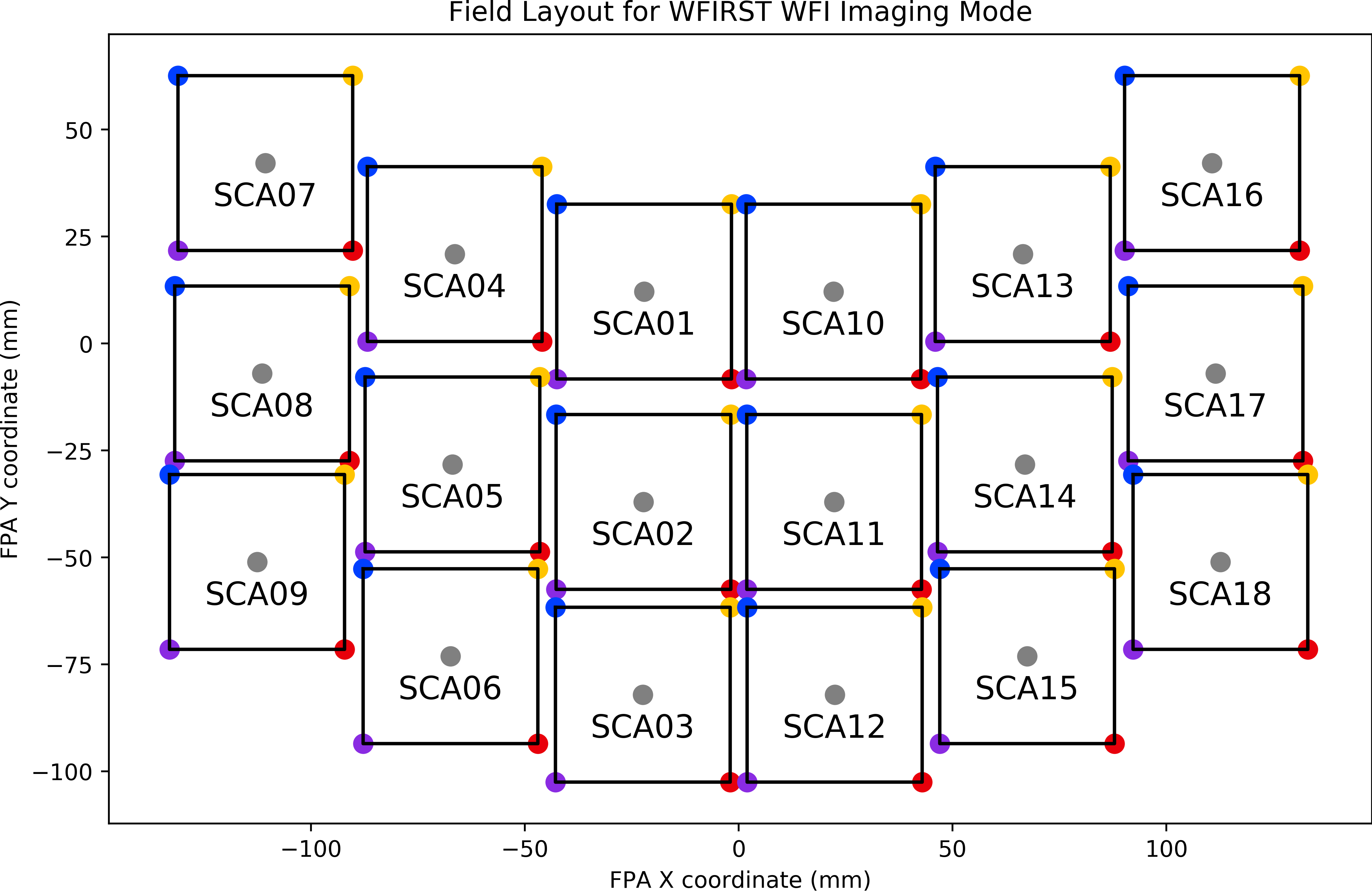
The Wide Field Instrument’s field of view, as projected on the sky.
The WFI field of view is laid out as shown in the figure. To select a different detector, assign its name to the detector attribute:
>>> wfi.detector_list
['WFI01', 'WFI02', 'WFI03', 'WFI04', 'WFI05', 'WFI06', 'WFI07', 'WFI08', 'WFI09', 'WFI10', 'WFI11', 'WFI12', 'WFI13', 'WFI14', 'WFI15', 'WFI16', 'WFI17', 'WFI18']
>>> wfi.detector = 'WFI03'
The usable, photosensitive regions of the Wide Field Instrument’s detectors are slightly smaller than their 4096 by 4096 pixel dimensions because the outermost four rows and columns are reference pixels that are not sensitive to light. To change the position at which to calculate a PSF, assign an (X, Y) tuple:
>>> wfi.detector_position = (4, 400)
The reference information available gives the field dependent aberrations in terms of Zernike polynomial coefficients from \(Z_1\) to \(Z_{45}\). These coefficients were calculated for five field points on each of 18 detectors, providing coverage from 0.76 \(\mu m\) to 2.3 \(\mu m\) (the WFI’s entire wavelength range). STPSF interpolates the coefficients in position and wavelength space to allow users to simulate PSFs at any valid pixel position and wavelength. STPSF approximates the aberrations for an out-of-range detector position by using the nearest field point.
Bear in mind that setting a pixel position does not automatically set the
centering of a calculated PSF. As with other models in STPSF, specify
‘even’ (centered on crosshairs between four pixels) or ‘odd’
(centered on pixel center) parity through the options dictionary.
>>> wfi.options['parity'] = 'even'  # best case for dividing PSF core flux
>>> wfi.options['parity'] = 'odd'  # worst case for PSF core flux landing in a single pixel
Example: Computing the PSF difference between opposite corners of the WFI field of view
This example shows the power of STPSF to simulate and analyze field dependent variation in the WFI model. A dozen lines of code produce a figure showing how the PSF differs between the two extreme edges of the instrument field of view.
>>> wfi = roman.WFI()
>>> wfi.filter = 'F129'
>>> wfi.detector = 'WFI09'
>>> wfi.detector_position = (4, 4)
>>> psf_wfi09 = wfi.calc_psf()
>>> wfi.detector = 'WFI17'
>>> wfi.detector_position = (4092, 4092)
>>> psf_wfi17 = wfi.calc_psf()
>>> fig, (ax_wfi09, ax_wfi17, ax_diff) = plt.subplots(1, 3, figsize=(16, 4))
>>> stpsf.display_psf(psf_wfi09, ax=ax_wfi09, imagecrop=2.0,
                      title='WFI09, bottom left - F129')
>>> stpsf.display_psf(psf_wfi17, ax=ax_wfi17, imagecrop=2.0,
                      title='WFI17, top right - F129')
>>> stpsf.display_psf_difference(psf_wfi09, psf_wfi17, ax=ax_diff,
                                 vmax=5e-3, title='WFI09 - WFI17', imagecrop=2.0)
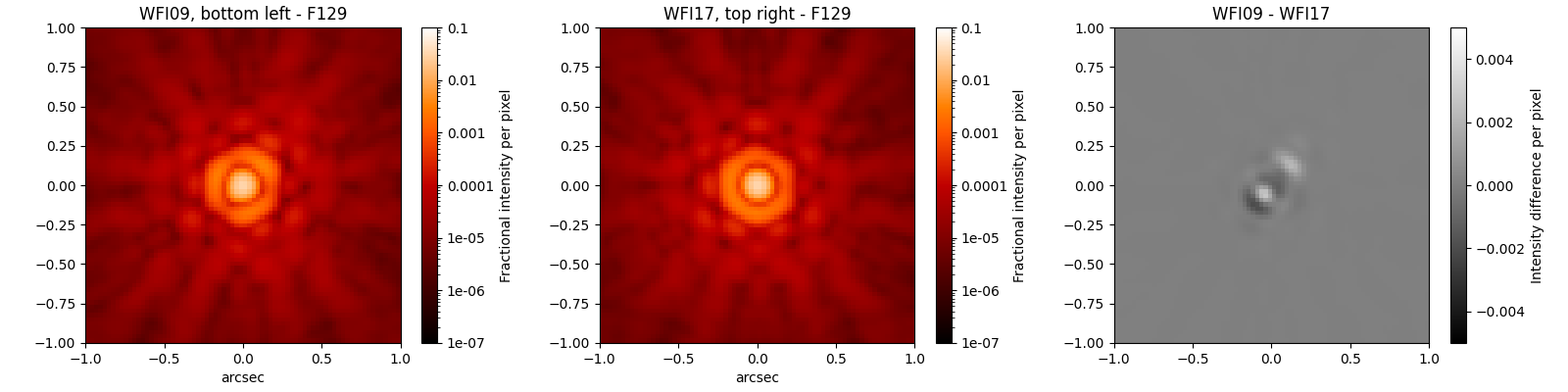
This figure shows oversampled PSFs in the F129 filter at two different field points, and the intensity difference image between the two.
Pupil variation and pupil masks in the WFI model
As before, the Cycle 10 reference data release from the Goddard Space Flight Center features field-dependent pupil images for the WFI. However, this cycle’s pupil images are categorized in a manner that diverges from that of previous cycles.
For the first time, each WFI imaging filter comes with its own set of
field-dependent aberrations and pupil images. This eliminates the need to group
filters into broader pupil masks as was done in previous releases. For example,
in STPSF version 2.0.0, the F184 and F213 filters shared the 'Wide' pupil
mask. Both filters now have separate “F184” and “F213” pupil masks. The same is
true for the shorter wavelength imaging filters and the prism. (The prism mode
operates without obstruction, so it is only assigned a “pupil mask” in STPSF
for the sake of consistency with other optical elements.) The “GRISM0” and
“GRISM1” filters still share a “GRISM” pupil mask.
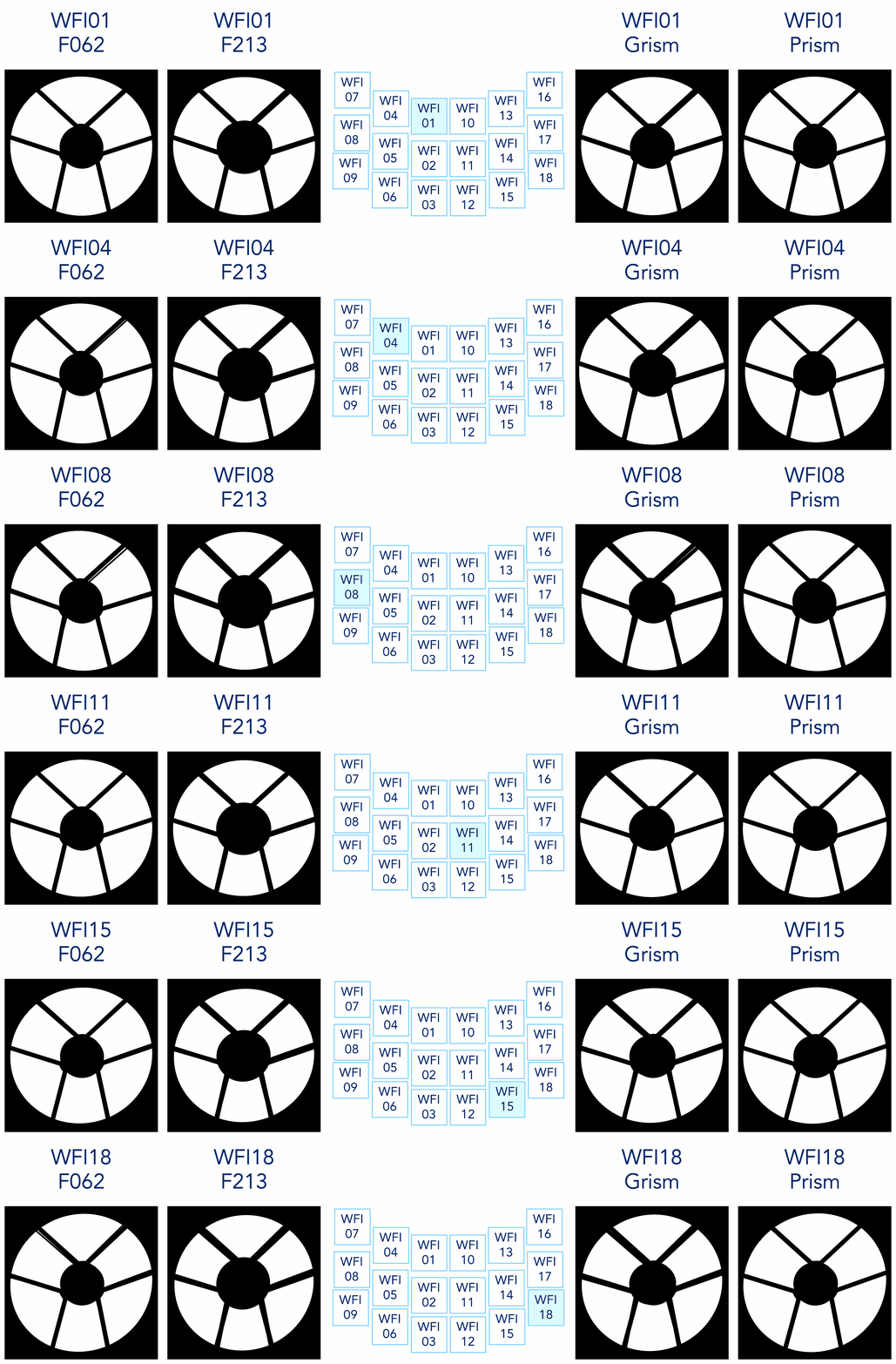
Pupil masks at different field points.
The pupil and pupil mask are dynamically selected as needed whenever the detector or filter is changed. To override this behavior for either attribute, see WFI.lock_pupil() and WFI.lock_pupil_mask().
Coronagraph Instrument
We have begun developing a Coronagraph Instrument simulation module. The goal is to provide an open source modeling package for the Coronagraph Instrument for use by the science centers and science teams, to complement the existing in-house optical modeling capabilities at JPL.
Currently a prototype implementation is available for the shaped pupil coronagraph modes only, for both the Coronagraph imager and IFS. Future releases will incorporate realistic aberrations, both static and dynamic, to produce realistic speckle fields. We also plan to add the hybrid Lyot modes.
Warning
The Coronagraph model has not been actively updated or developed since circa 2017. It does not well represent the current PDR-level state of the instrument. There are plans to refresh this model. Interested users should contact Ewan Douglas.
Warning
Current functionality is limited to the Shaped Pupil Coronagraph (SPC) observing modes, and these modes are only simulated with static, unaberrated wavefronts, without relay optics and without DM control. The design represented here is an approximation to a baseline concept, and will be subject to change based on ongoing trades studies and technology development.
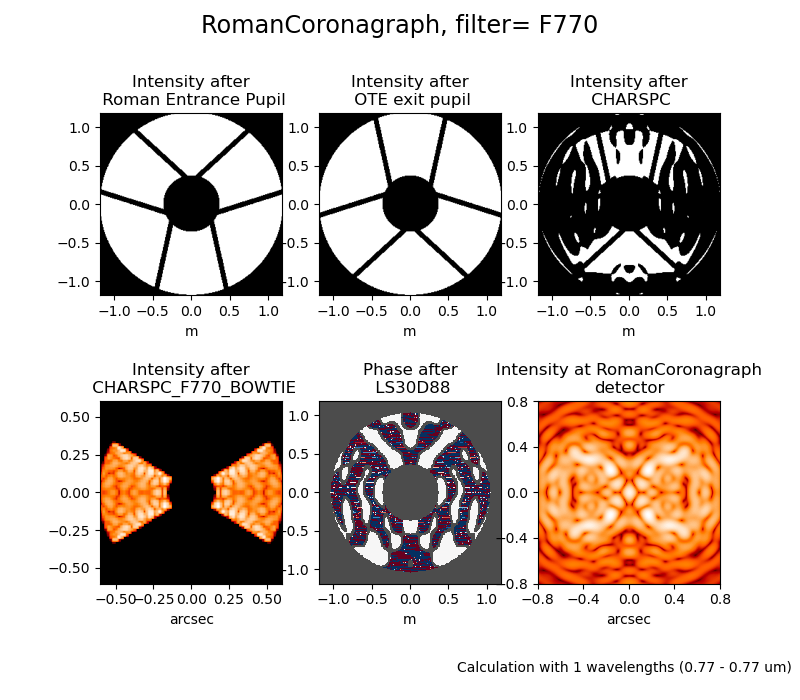
A hands-on tutorial in using the RomanCoronagraph class is available in this Jupyter Notebook. Here we briefly summarize the key points, but see that for more detail.
The RomanCoronagraph class has attributes for filter, etc., like other instrument classes, but since these masks are designed to be
used in specific combinations, a mode attribute exists that allows easy specification of all those attributes at once. For example, setting
>>> cor = roman.RomanCoronagraph()
>>> cor.mode = "CHARSPC_F770"
is equivalent to:
>>> cor.camera = 'IFS'
>>> cor.filter = 'F770'
>>> cor.apodizer = 'CHARSPC'
>>> cor.fpm = 'CHARSPC_F770_BOWTIE'
>>> cor.lyotstop = 'LS30D88'
There are _list attributes that tell you the allowed values for each attribute, including a mode_list for all the available meta-modes.
Calculations are invoked similarly to any other instrument class:
>> mono_char_spc_psf = cor.calc_psf(nlambda=1, fov_arcsec=1.6, display=True)